
Chloé Larrère
2026
Belgium, France
French
fiction
drama | absurd | comedy
24 minutes
Initial Films (Belgium) in co-production with Melocoton (France)
Aurore is a rising star in the world of ASMR, and already has thousands of subscribers to her YouTube channel ‘Les sons de l’Aurore’. Her next episode is dedicated to listening to birds. So she’s off to the heart of the Ardennes forest. But what she doesn’t know is that not far away, a chemical plant has just exploded.
Aurore | Mouna Soualem
Peter | Harpo Guit
Marjo | Sarah Lefevre
Monique | Delphine Breger
Nini | Ninon Borsei
Simon | Florian Pautasso
The journalist | Grégoire de Monsaingeon
Thierry | Paya
Director & Screenwriter | Chloé Larrère
Co-Screenwriter | Flora Krivine
Producer | Félix Lambot
Producer | Hélène Mitjavile
Producer | Théo Laboulandine
Producer | Pierre Mourey
Music Composer | Adrien Guerne
1st Assistant Director | Angel Adhera
2nd Assistant Director | Angel Adhera
Script Supervisor | Baptiste Guiard
Animal Handler | Laurie Habousha
Production Manager | Morgane Bienfait
Location Manager | Roxanne Timperman
Location Manager Assistant | Hugues Poysat
Location | Martin Courtant
Director of Photography | Adrien Heylen Vanorlé
Focus Puller | Léa Treuil
2nd Assistant Camera | Santiago Lechaptois
Steadicam | Inès Bedrouni
Set Designer | Louise Vandervorst
1st Assistant Decorator | Nine de Bryas
Decorator | Cloé Sauvage
Props Master | Charlotte Hermant
Costume Designer | Milena Forest
Hair & Make-up Artist | Sirine Srijetanont
Sound Engineer | Pierre-Nicolas Blandin
Boom Operator | Lancelot Herve
Key Grip | Cyril Hermant
Grip | Cyril Marbaix
Grip | Oscar Vanden Abeele
Gaffer | Camille de Patoul
Spark | Noé Michelet
Post-production Manager | Pierre Mourey
Editor | Laureline Maurer
Editor's Assistant | Anna Dossmann
Editor's Assistant | Amélie Moulin
Sound Editor | Colin Favre-Bulle
Foley Artist | Claire André
Recorder | Mickaël Olivier
Mix | Selia Çakir
Colorist | Loup Brenta
BSFF - Brussels Short Film Festival - 2026 | Brussels, Belgium
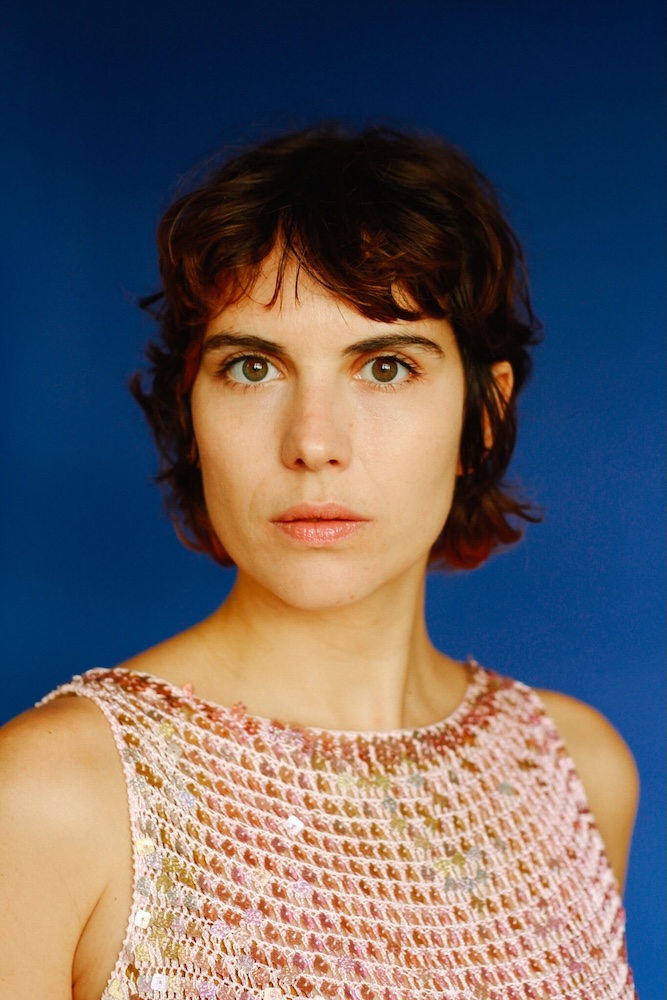
Chloé Larrère studied acting at INSAS in Brussels, graduating in 2018. Alongside her training, she developed her own writing practice at the intersection of performance and theatre, directing several of her own works.
She also creates films in close collaboration with small crews, embracing a raw and punk-inspired approach to storytelling. Her short film Pupuce won the Grand Prix at the Brussels Short Film Festival in 2024.
She later directed SCRITCH SCRITCH (2026), followed that same year by her new short film Il est mort le soleil.
In parallel, she directs music videos for various European artists.
- Pupuce (2023, short film)
- Pumpkin (2023, short film)
- Gouroue (2025, music video)
- Il est mort le soleil [The Sun has Died] (2026, short film)
- Scritch Scrtch (2026, short film)
Chloé wanted to highlight my vision of human vulnerability—the inevitable, laced with poetry and humor, even though, no matter what, the planet is burning. This project isn’t an accusatory film; instead, it paints a generational portrait in the face of the ecological catastrophe we’re living through. She was shaped by the stories and post-Chernobyl anecdotes of her parents and their friends. "When you listen to them, it’s like the cloud just skirted around our beautiful country... My ass!" her mother would say, laughing bitterly.
She writes with the urge to speak about her generation—raised in artificial environments, yet obsessively trying to reconnect with nature through various mediums, all without leaving their homes. It’s about our generation’s relationship with the irreversible: the last eternal snows (an oxymoron of the present), congenital malformations, the rising tide of cancers, species extinction... And yet.
Scritch Scritch was born during lockdown. One evening, between the 8 p.m. news—flashing infection rates and the weather forecast—slipped a tiny segment, a brief report on life in Rouen after the Lubrizol plant fire, which had happened just months before the COVID-19 pandemic began. She imagined the surrounding nature and how life might have frozen in the wake of that disaster. She started writing little scenes, seen through the eyes of a fictional character, Aurore—a young urban woman she could identify with, exaggerating her quirks to the point of absurdity. She walked through the forest, imagining the mental trajectories of this hyper-connected yet isolated woman, lost in her world of amplified noises.
Chloé loved the idea of a sudden, deep interest in nature—perhaps out of guilt, a feeling her generation often grapples with. She wanted to give it form in a film, to weave it into a narrative framework, and to let Aurore carry a story. Making Aurore an ASMR professional provides a formal structure for her monologues. Plus, Chloé finds the practice both soothing and excruciatingly painful. Scritch Scritch is also the sound of gentle scratches, a longing for tenderness in a world that’s literally exploding in our faces. It’s a dark comedy where snippets of lives collide in the wrong place, at the wrong time.
SCRITCH SCRITCH is driven by highly expressive performances and vividly eccentric characters, carried by an absurd energy and a distinctly Belgian sense of humour. Through this offbeat universe, the film playfully twists the codes of wellness culture, ASMR, and online influence with a sharp sense of contrast.
Beneath its strange lightness, something more unsettling gradually emerges. The tension between artificial softness and looming disaster gives Chloé Larrère’s cinema a singular, bold, and unconventional tone — somewhere between satire, discomfort, and dark fantasy.